The Right Technology for Your Supply Chain Planning
.avif)
Does it always have to be a specialized solution?
How to Make Better Decisions with the Right Planning Technology
Volatile markets, supply bottlenecks, geopolitical factors, and rising cost pressures are presenting companies with increasingly complex planning challenges. Traditional, isolated planning approaches are increasingly reaching their limits.
Many organizations today struggle with fragmented processes, inconsistent forecasts, and a lack of alignment between operational and financial planning. And this is exactly where modern planning tools come in: They integrate data, processes, and organizational units into a unified planning approach.
There is a wide range of systems available. For many companies, this raises the question: Which tool is the right one for our specific needs? In this blog post, we compare key solutions such as Board, Anaplan, SAP IBP, SAP Analytics Cloud, and Kinaxis— and highlight what really matters when making a selection.
From Silos to Integrated Planning: Why Tools Are Essential Today
In many companies, the technological foundation is already in place: ERP, CRM, and HR systems provide key data throughout the value chain. Nevertheless, the actual planning often takes place outside of these systems—in Excel or in standalone solutions that have evolved over time.
The result is a fragmented planning approach in which departments operate in isolation, information is consolidated only after a delay, and coordination requires a significant amount of manual effort. Inconsistent data, parallel forecasts, and a lack of transparency regarding economic impacts are not exceptions but are, in fact, widespread in practice. Especially in an environment characterized by rapid market changes, this type of planning is increasingly becoming a risk: Decisions are often based on outdated or incomplete information, running through scenarios requires considerable effort, and the effects on costs, margins, or capacities remain unclear for a long time.
This is exactly where modern planning tools come in. They act as a connecting layer between existing systems and lay the foundation for a seamless, integrated planning process. Instead of laboriously consolidating data, they provide a consistent, cross-functional view of the company—and thus enable more informed decisions in less time.
Modern planning tools make it possible, in particular, to:
- Integration of Sub-Plans (e.g., Demand, Supply, and Finance)
- Faster and Automated Scenario Calculations
- Uniform, consistent decision-making criteria across all areas

However, how these requirements are implemented in detail and where the respective strengths lie varies significantly depending on the tool and the underlying approach.
Platform vs. Custom Solution: Two Fundamental Approaches
When selecting planning tools, companies are essentially faced with a strategic choice: Should they opt for multiple specialized solutions—or for an integrated platform? This decision shapes not only the system landscape but also the way planning is carried out within the company.
1. Best-of-Breed
In the best-of-breed approach, several specialized tools are used in parallel—each optimized for a specific area of application, such as sales planning, supply chain management, or financial planning.
The major advantage lies in the depth of expertise: Each tool is precisely tailored to its specific use case and typically offers highly sophisticated functionality. Especially when dealing with complex requirements—such as in production or network planning—this allows for the modeling of highly specialized scenarios that would often be possible only to a limited extent with generic platforms. Particularly with complex supply chain structures—such as those that were often modeled in the past using SAP APO-SNP—there is frequently no alternative to using a specialized solution. Tools like Kinaxis provide the necessary depth to reliably support complex network, inventory, and capacity planning.
However, this comes with integration efforts that should not be underestimated. Different systems must be connected, data synchronized, and processes coordinated. This not only leads to more interfaces and a greater need for coordination, but also often results in inconsistent data across departments. In addition, operating and licensing costs rise when multiple solutions are run in parallel.
2. Integrated Planning Platform
The alternative approach is to use a central platform that consolidates multiple planning processes into a single solution. The goal is to break down silos and provide a comprehensive view of the entire company.
The focus here is not on the maximum specialization of individual functions, but rather on the integration of planning across departments—for example, from sales through the supply chain to financial planning. This creates a unified database that serves as the foundation for all stakeholders’ work.
This significantly reduces the complexity of the system landscape and makes coordination much easier. At the same time, companies benefit from an end-to-end view of their planning: Changes in one area become immediately visible, and their impact on other areas can be assessed directly.
However, this approach also has its limitations. Since the platform must address many requirements simultaneously, specialized functions—such as those related to in-depth supply chain planning—are sometimes less robust than in dedicated solutions.
What does this mean for tool selection?
There is no one-size-fits-all answer when choosing between the two approaches. The decision depends largely on which requirements are a priority for the company:
- Is maximum depth of expertise in specific areas crucial?
- Or does the need for integration and transparency across all planning processes take precedence?
In practice, it has become clear that the greater the emphasis on cross-departmental collaboration, the more important an integrated platform approach becomes. Conversely, specialized tools are particularly useful in situations where technical complexity and depth of detail are the deciding factors.
A Comparison of the Most Important Planning Tools
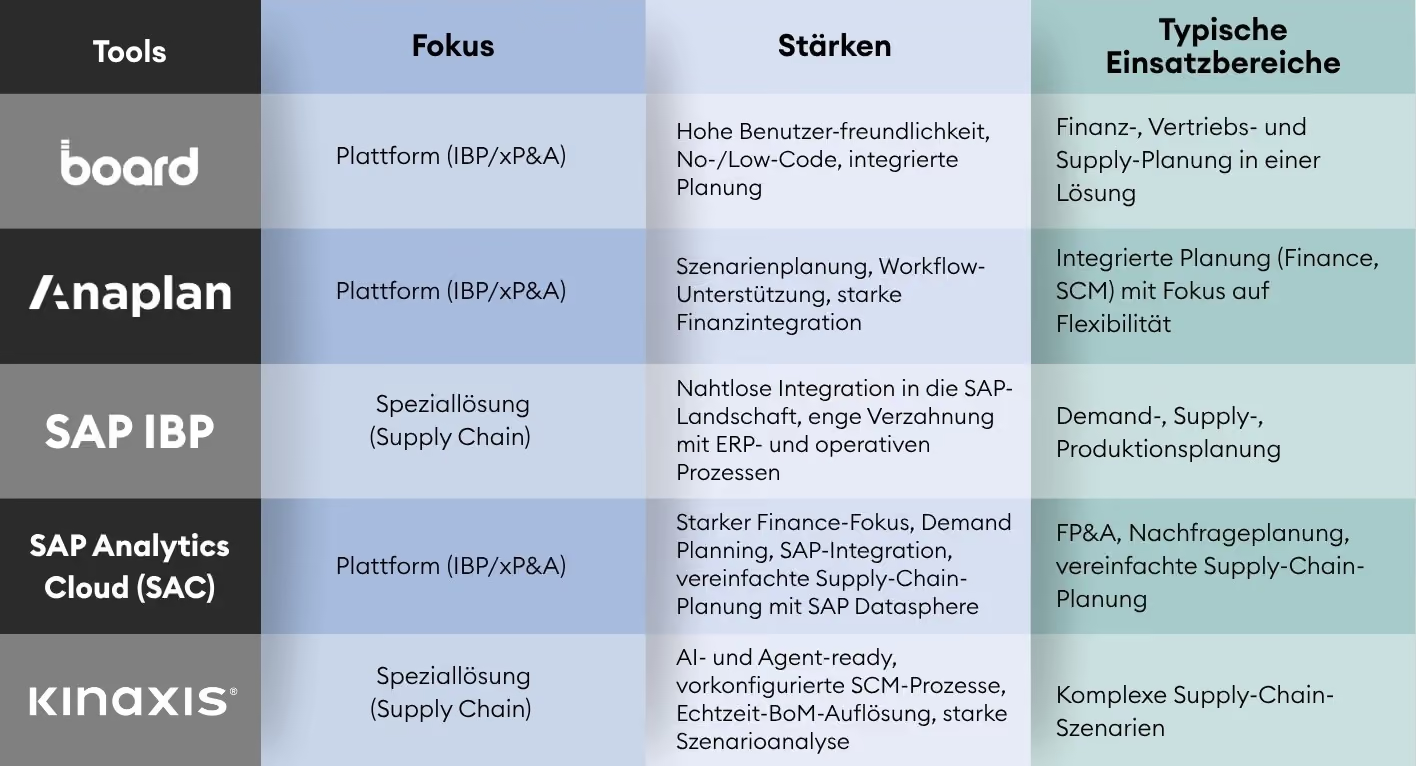
Strengths in Detail: Where the Tools Really Differ
When evaluating planning tools, it quickly becomes clear that the differences lie less in their basic functionality and more in their areas of focus. The key factor is how well a tool supports specific requirements—especially in areas where planning becomes complex in practice.
1. Integration of Financial and Operational Planning
One of the biggest challenges in many companies is integrating operational planning with financial planning. While the supply chain is typically volume-driven, the finance department focuses on metrics such as revenue, costs, and margins.
These different perspectives come together in the planning process—though often without a consistent link between them. The result is inconsistencies: forecasts do not align, effects on the income statement become apparent only late in the process, and decisions are based on incomplete information.
Modern planning tools address this very issue and bridge the gap between these two worlds. Platform solutions, in particular, make it possible to:
- Consistent planning models across quantity and value levels
- an automated process for translating operational plans into financial structures, such as the income statement
This ensures greater transparency and provides a significantly better basis for decision-making—especially when it comes to cross-functional issues.
2. Scenario Planning and Speed
In addition to integration, the speed of planning is playing an increasingly important role. In dynamic markets, a static annual plan is no longer sufficient. Companies must be able to make regular adjustments, respond quickly to changes, and assess the impact of various scenarios.
In practice, traditional, manual planning approaches quickly reach their limits here. Those who run through scenarios in Excel often work with a time lag—and run the risk of making decisions based on outdated data.
Modern planning tools offer clear added value in this area: They automate key steps in the planning process and enable significantly faster iterations. These include, in particular:
- Automated consolidation of forecasts from various departments
- Simulation of demand, price, or cost effects
- Significantly shorter decision-making cycles thanks to readily available scenarios
The result: Planning evolves from reactive reporting into a true management tool.
3. Depth of Expertise vs. Flexibility
Another key difference between the tools lies in the trade-off between technical depth and flexibility.
Specialized solutions such as SAP IBP or Kinaxis are designed to map complex supply chain processes in as much detail as possible. They offer comprehensive functionality for areas such as demand forecasting, network planning, and capacity management.
In contrast, there are platform solutions such as Board or Anaplan, which focus less on individual business units and instead enable broad use across various departments. Their advantage lies in their flexibility and the ability to map different planning processes within an integrated environment.
SAP Analytics Cloud, on the other hand, plays an intermediate role: It is particularly widespread in the finance department, while operational planning—especially at a detailed level—is typically still carried out in combination with other solutions such as SAP IBP.
Ultimately, it becomes clear that this trade-off cannot be fully resolved. Companies must decide whether they need maximum detail in individual areas or whether cross-functional integration is the priority.
.avif)
Conclusion: The tool must be compatible with the planning logic
Choosing a planning tool is much more than just a technical decision. It has a significant impact on how planning is organized within the company, how quickly decisions can be made, and how well different departments work together.
The biggest mistake is to view the tool in isolation. Instead, the focus should be on the question: What planning approach does the company follow —and which solution best supports it? After all, true added value is created only when processes, data structures, and system architecture are aligned.
Especially against the backdrop of increasing dynamism and growing complexity, it is clear that integrated planning is becoming a critical success factor. Companies that succeed in aligning their operational and financial perspectives gain a clear competitive advantage—through greater transparency, faster responsiveness, and more informed decisions.
Above all, the fundamental choice between a platform-based approach and a specialized solution is key. It determines whether the focus is more on integration and end-to-end transparency or on maximum technical depth in specific areas. In many cases, it is less a matter of “either/or” and more about finding the right combination within a clearly defined target architecture.
We’d be happy to help you analyze your planning landscape, define clear requirements, and develop the right solution to meet your goals. Just get in touch with us.


Blog post author
.avif)

Janek Kapahnke has been developing planning and analysis solutions with customers from various industries for over 5 years. Today, he is responsible for the area of supply chain management and focuses on innovative solutions for current challenges in supply chain planning.


.svg)
