Fissler GmbH

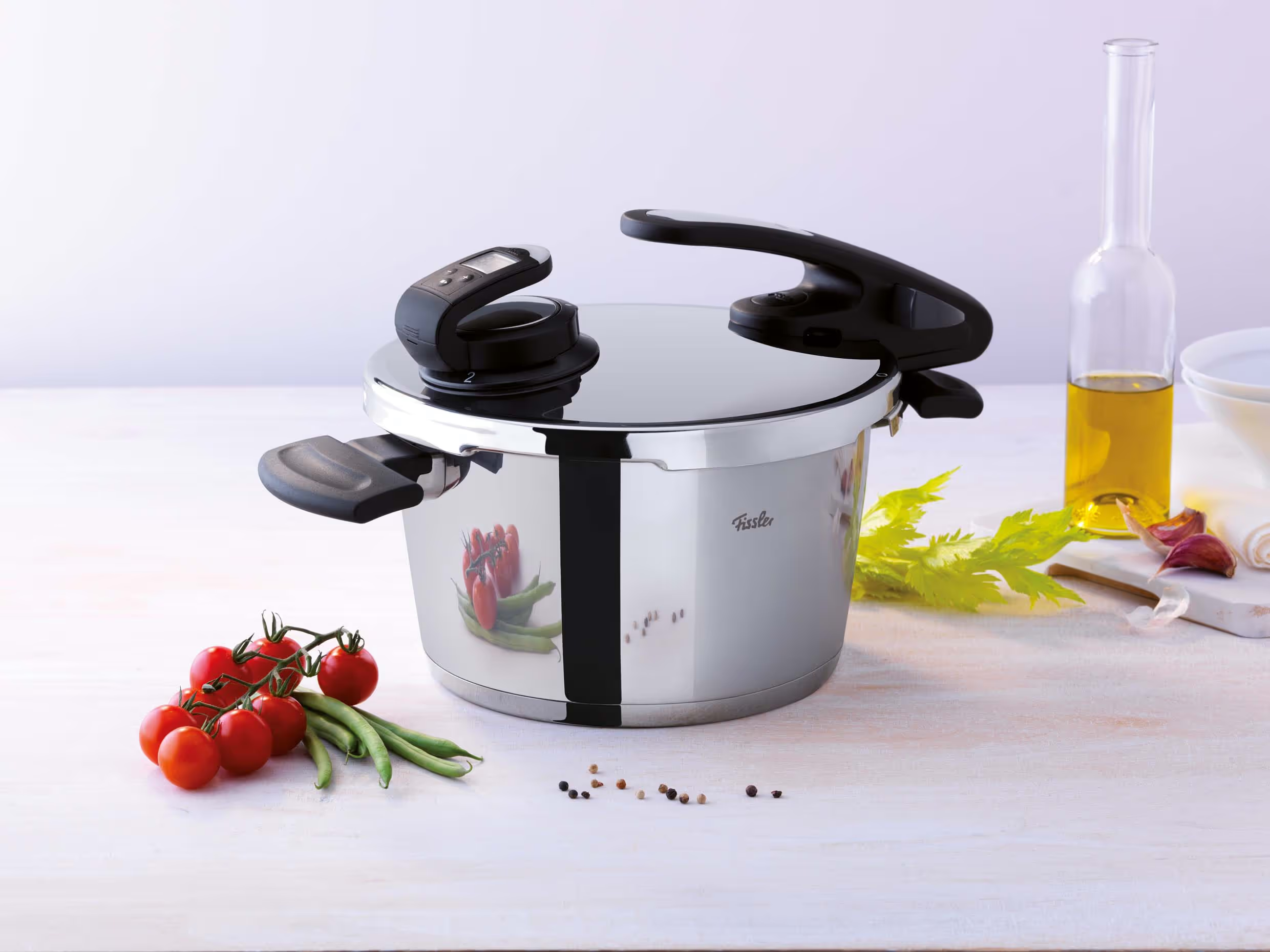
Fissler has been using Board for reporting and planning since 2004. As part of a comprehensive relaunch , the company once again opted for the no-coding tool and selected celver AG as its implementation partner. Consequently, our consultants migrated the solution to the new version of Board, expanded and revised the individual planning modules, and integrated the results with the legacy SAP system. As a result, Fissler now has an integrated demand planning system at its disposal for the optimal management of inventory and downstream processes.
The Company: Premium Cookware
For decades, Fissler GmbH has been synonymous with high-quality cookware. The company has filed over 200 patents and utility models in the last 50 years alone. The German family-owned business was founded in 1845 by Carl Philipp Fissler in Idar-Oberstein and employs 789 people worldwide.
Fissler's premium products are "Made in Germany" and available in over 70 countries.
The facts at a glance:
✓ Improved planning quality through greater accountability
✓ Direct integration with the upstream SAP system
✓ Planning results have a direct impact on purchasing, production, and inventory
✓ Technical flexibility in data integration
✓ Planning process including workflow
✓ Multilingual support
The challenge: interface integration and updating
Since late 2004, Fissler has been using a reporting and planning solution based on Board—known internally at Fissler as VIPS (Sales Information and Planning System). As part of the restructuring of all supply chain processes , new and changing requirements arose for VIPS—including the integration of planning with SAP.
Based on its positive experience working with celver AG, Fissler approached the company with its upgrade requirements. Fissler had already developed the specific requirements internally and documented them in a requirements specification.
The Solution: Demand Planning in Four Modules
With regard to the new architecture, celver AG recommended implementing a data warehouse (DWH) based on Microsoft SQL Server. This made it possible, on the one hand, to easily meet the new and critical requirement of writing data back to the SAP source system and, on the other hand, to integrate additional international corporate data. In the future, the planning process was to generate binding SAP purchase orders and demand quotas. The interface between the DWH and SAP is enabled by the Xtract IS tool from Theobald Software GmbH, as well as by an interface adaptation on the SAP side. Fissler’s IT department played a key role in this process. As a result, Fissler now has a clear and flexible, state-of-the-art architecture at its disposal, combined with appropriate flexibility for further data integration.
At the start of the project, the celver AG consultants converted and cleaned up the legacy structures of the previous system, set up the data warehouse, and implemented the interface to SAP. The relaunch of the planning solution could then begin. The system comprises four volume-based modules: annual preliminary planning, central annual planning, monthly rolling forecast, and promotional planning (domestic). The entire planning process serves as demand planning and is carried out by sales managers. In this process, sales figures are calculated based on historical prices and serve as benchmarks for the planners. Annual preliminary planning serves as an initial estimate for the following year and is entered directly into SAP as primary demand.
Planning is based on suggested values calculated from historical data over the past 12 months, taking target figures into account. For new items, product management estimates quantities to serve as suggested values for planning. Automatic suggested values can be generated for this purpose using customer distribution or item referencing. In total, Fissler plans up to 2,000 items. To ensure a focused approach, the planner is shown a breakdown of items into categories for their specific sales territory: the 80 top-selling items, items with sales of more than 1,000 units in the past 12 months, new items, and the remaining items.
Using this breakdown, the sales manager plans quantities at the item level and can flexibly adjust details down to the customer level. An item history is available for reference. It displays detailed item information ranging from the material number, delivery class, and industry classification to the actual sales volumes per month for the last 36 months. Additionally, the top 10 customers for this item and a graphical and tabular comparison of planned versus actual figures are visible.
The tool’s multilingual capabilities, along with language-specific databases for subsidiaries, make it easy for planners abroad to navigate the system. To improve on-time delivery and planning quality, submission deadlines are displayed, plans are centrally reviewed and approved, and all status data is documented. After the preliminary planning has been completed and reviewed, Central Controlling transfers the plan values to SAP. Here, the plan quantities from VIPS are automatically converted into SAP primary requirements, which are later specified as monthly quotas during the rolling forecast.
The results of the annual bottom-up preliminary planning are incorporated not only into the rolling forecast but also into the central annual planning process. Here, the headquarters in Idar-Oberstein uses sales volumes as a basis to plan target prices, taking into account seasonal effects, trends, and special promotions, thereby generating a refined sales plan and detailed contribution margin planning. Once the annual preliminary planning is finalized and approved, the rolling forecast begins with a one-month lead time for the three subsequent months. The sales manager is presented with the values resulting from the preliminary planning, adjusted to account for new customers and new products from the previous rolling forecast month. Excessive deviations from the previous month, +/- 25 percent, are immediately visible to the planner in color-coded form using the traffic light principle. Missing items or new customers can be added manually and assigned suggested values via referencing or based on average values.
Once planning is complete, the planned quantities are converted into SAP quantity quotas for the sales managers. In international planning, SAP orders are also sometimes generated starting in the first planning month. The rolling forecast is therefore intentionally highly binding. Inaccurate planning or missing plan values have a direct impact on individual performance. It is therefore in the sales managers’ own interest to plan on time and with due consideration. Through this approach, Fissler aims to highlight the high relevance of demand planning, improve planning quality, and ultimately support the optimization of supply chain processes—from purchasing through logistics, production, and warehousing. The celver AG consultants implemented the Promotional Planning module in a manner analogous to the old version. This module is used to plan the specific aspects of promotional activities. The results are incorporated into the rolling forecast as supporting information for sales managers. Another step in the system relaunch is the Information System module , which covers all reporting functions. Implementation is primarily handled by Fissler’s key users, who draw on celver AG’s expertise as needed.
A structured planning process (supported by a corresponding workflow in Board) assists everyone involved in the planning process. With the relaunch of its integrated demand planning system, Fissler is creating an even more robust foundation for demand-optimized production and procurement planning.
Accurate and reliable planning ensures that Fissler customers receive timely, reliable, and flexible service. At the same time, optimizing finished goods inventory is a key factor in reducing tied-up capital.


Your contact person
.avif)